Kenyon · male CNS connectome · Janelia + Google Research
We taught a fruit fly to make beautiful websites
2,045 measured Kenyon cells, a measured feedback loop and 17,985 measured synapses — and the ones firing right now are turning inside its head. It was shown two versions of the same Ammoura storefront, identical words and opposite design, then rewarded on the one built from Ammoura's own theme tokens and punished on the one built the way generated design usually is. Everything on the screen below is what it picked.
—Kenyon cells
drag its head to turn the circuit · scroll to zoom
Kenyon cells —
What the fly thinks of this page
Its preference for the best candidate, generation by generation. A page it has no opinion about scores zero. For scale, an odour the fly was trained on directly reaches ±0.25.
The two brains, after the lesson
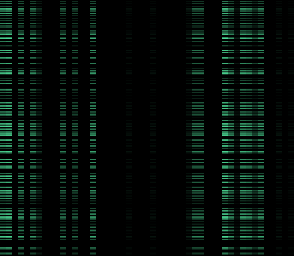
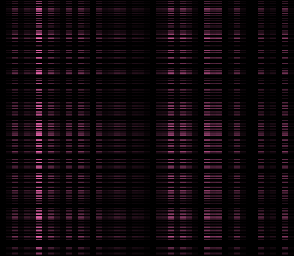
2,045 × 49 synapses, blocked down the long side. Lit means the lesson weakened a synapse there; black means it never touched one. This is the only difference between the two flies.
What each fly ended up building — and what holds up
Six flies ran from the same starting pages with the same mutations: the two twins, a naive fly with no lesson, and three mis-aimed flies given the same reward with the dopamine delivered to the wrong compartments. KC overlap is how much of the Kenyon-cell code each final page shares with the page the fly was taught, and vs random places that against 30 pages nobody selected.
The write-up
What this actually taught us — including the parts that did not work, and an honest comparison against the ordinary ways of getting the same result. It is being written now. Leave an address and it arrives once, as a PDF, when it is finished. A draft is readable now.
One email, the report, nothing else. The address is stored and not shared.
What this is standing on
None of the wiring here was invented. It was measured by other people, over years, and published so that anyone could run it. These are the specific things this page is built out of.
The animal
- Male CNS connectome, v1.0 Janelia FlyEM and Google Research, CC BY 4.0. Every neuron and every synapse in this model comes from here.
- The flat connectome tables body annotations and 1.1 GB of weighted edges — what the circuit is extracted from.
- Reconstructed skeletons one Neuroglancer precomputed file per body, in nanometres. The shapes turning in the fly's head are these, 317,767 segments of them.
- Janelia FlyEM · Google Research connectomics · neuPrint
The circuit
- Kenyon, 1896 The brain of the bee. The cells this project is named after, drawn through a microscope 130 years ago. 10.1002/cne.910060302
- Caron, Ruta, Abbott & Axel, 2013 Olfactory input to Kenyon cells converges at random — why the expansion layer can be treated as an arbitrary code. 10.1038/nature12063
- Lin, Bygrave, de Calignon, Lee & Miesenböck, 2014 APL's feedback makes the code sparse. The 8% this model reproduces is their result. 10.1038/nn.3660
- Aso et al., 2014 The compartment map: which dopamine neuron teaches which output neuron, and what each compartment means. 10.7554/eLife.04577
- Hige, Aso, Modi, Rubin & Turner, 2015 The plasticity rule itself — dopamine depresses the KC→MBON synapses that were active. It is the only thing that changes here. 10.1016/j.neuron.2015.11.003
- Dasgupta, Stevens & Navlakha, 2017 The same circuit read as an algorithm. The reason a page can be handed to it as if it were a smell. 10.1126/science.aam9868
The build
- Playwright and headless Chromium every candidate and every reference page is rendered, then measured from the pixels and computed styles.
- NumPy, pandas and Apache Arrow the circuit is matrices, and the connectome ships as Feather.
- Neuroglancer precomputed skeletons the format the shapes are read out of.
- WebGL, hand-written no 3D library: line rendering needs a small enough part of one that 600 kB was not worth the download.
- Cloudflare Workers · IBM Plex · Bodoni Moda
The rules it is judged by
- Ammoura
the storefront this is trained on. The tokens are read straight
out of its
src/app.cssbyammoura.py, so the reference moves when the product does. The page it was rewarded on is built from them; the one it was punished on is not. - NebulaKit where the contrast gate came from — a design system that fails a build over it.
- WCAG 2.1 contrast minimum 4.5:1 for normal text, 3:1 for large. Measured on every page here, not asserted.
- *Space · Ammoura · Guides